David Cotterrell | Mirror V: Translation
Danielle Arnaud, London, October 2019
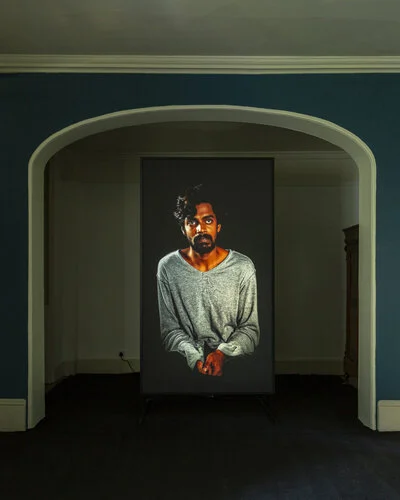
David Cotterrell, Mirror V: Translation, 2019, Single-channel video with four-track audio, Collaboration with Ruwanthie de Chickera, Dimensions variable. Image courtesy the artist and Danielle Arnaud, London. Photograph by Oskar Proctor.
Truth is a thing of this world: It is produced only by virtue of multiple forms of constraint. And it induces regular effects of power. Each society has its own regime of truth, its "general politics" of truth: that is, the type of discourse which it accepts and makes function as true. – Michel Foucault, Power | Knowledge, pp. 131
Translation shores up truth, moulding it into the outline of a specific agenda. Extending beyond words, translation clings to the visual and creates a rhetoric. In a society laden with visual signifiers, nothing can exist without subjective meaning, washed with our ideologies; our upbringings; the views of those with whom we surround ourselves. We see what we anticipate or what we fear, not what our eyes truly register. A backpack left on the tube, visibly filled with books or clothes, becomes a bomb even in its absence of wires. We transpose our fears into our surroundings, led by our prejudices in an absence of meaning. But in verbal or written translation, there is something about the definitive nature of writing, a suggestion of the contractual, that makes it perhaps even more powerful than our visual transpositions. The translation becomes evidence and is disseminated again and again, repeated as fact. The translator’s prejudice is poured between the words and made invisible, gluing the speaker’s mouth shut and branding them with new meaning.
David Cotterrell’s latest in his Mirror installations, Mirror V: Translation, explores the prejudice in translation, exposing how its nuances can mark the difference between perceived innocence and guilt; between a person portrayed as rightly frustrated with the immigration system, or as a terrorist. Cotterrell’s installation presents two Sinhala monologues, filmed in Sri Lanka, on screens in an otherwise dark room. As the viewer moves around the gallery space, they step beneath three ultrasonic speakers. Beneath each speaker they are engulfed by an invisible sonic bubble playing different translations of each monologue. The sound is ephemeral, as clear as though someone is whispering in your ear at one moment and then disappearing entirely with just a few inches of movement, simulating the wavering of truth in translation. The discrepancies between each translation initially seem minor but their cumulative effect is significant. In one monologue, our attention is triggered by words such as ‘recruiting’ and ‘bombing’, which we associate with terrorism. But in a different translation, this sinister suggestion of recruitment becomes a plea to join forces, and the word ‘bombing’ is eradicated completely. In this work, Cotterrell demonstrates how words can be weaponised both against the public in the media’s deliberate misleading, reframing and mistranslation to suit political agendas, but, most importantly, against the perceived ‘other’ in the subtleties of their demonisation.