Sarah Woodfine | Untitled (Forest)
Danielle Arnaud, London, October 2019
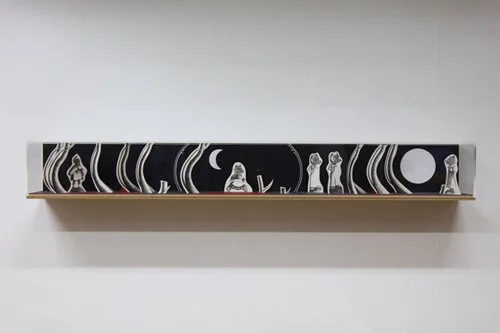
Sarah Woodfine, Untitled (Forest), 2016, MDF, pencil on paper, Perspex, 16x104x15cm. Image courtesy the artist and Danielle Arnaud, London. Photography by Oskar Proctor.
But the wolves have ways of arriving at your own hearthside. We try and try but sometimes we cannot keep them out. - Angela Carter, “The Company of Wolves,” from The Bloody Chamber and Other Stories
This idea of keeping out the wolves, of trying to restrain the uncontainable, is entrenched in our relaying of fairytales. Stories, myths and tales may physically be contained within the bindings of books but their most potent telling is through the mouths of others. They exist in oral histories, with their books remaining as material reference points, words spilling out of the sides. As Angela Carter retells the fairytale of Little Red Riding Hood in her short story “The Company of Wolves”, Sarah Woodfine retells, interprets and revises both stories in her work Untitled (Forest), mirroring the mutation that the story undergoes when passed from mouth to mouth.
Woodfine plays on the (im)possibilities of containment here, with the forest enclosed within the parameters of the art display. Its perspex box seals its world, allowing viewers visual entry but safeguarding them from the wolves within. Blurring the boundaries between drawing and sculpture, between the three dimensional and the two dimensional, Woodfine creates a stage set on which the viewer can remember the chill of a cracking twig in an uninhabited woodland, of wolfish eyes piercing between your ribs. The sinister nature of the beast is alluded to here but undercut by Woodfine’s characters that straddle both the human and the wolfish, emerging as creatures in drag. In this hybridity, Woodfine both dispels the hierarchy between human and animal and alludes to the human tendency to dress up our violence and mask its primacy.
With the neatly cut tops of trees and amputated limbs, (bandaged feet and stumps where hands once were, take centre stage), executed with Woodfine’s sharp monochrome pencil, we could believe that these cuts were clean. But with the red cloaked by the graphite trees and seeping from between the legs of the central wolf, a mother figure perhaps, we see that even the forest cannot camouflage its violence and its loss. We are privy to the underbelly of the forest here and its cannibalistic nature. Woodfine’s forest is a site of the unconscious; a place of transformation but also reparation. The wolves look towards the malevolant figure on the right, anticipating their own transitions through the stages of the moon until they enter the snarl of its madness, limbs intact.